
-
Services
Our Services
- Panel Beating
- Dent Removal
- Car Spray Painting
- Bumper Repair
- Windscreen Replacement
- Fleet Repairs Perth
- Hail Damage Perth
- Luxury Car smash repair
- Car Mechanic Perth
- Car Scratch Repair Perth
- Ceramic Coating
- Car Insurance Claim
- Minor Accident Repair
- full car respray Perth
- Car repainting perth
- colour change respray
- paint restoration Perth
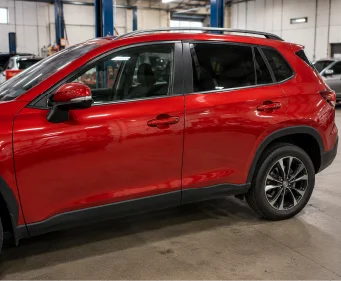
Car park damage in Perth is frustrating. It happens at shopping centres, hospital lots, train station park-and-rides, beachside car parks and multi-storey CBD buildings. Tight bays, reversing drivers and school pick-up chaos mean a car park knock can happen in seconds, leaving dents, scrapes and cracked bumpers. Most of the time it's minor property damage, and it usually happens while you're away from the car, but even minor damage can mean a repair bill in the hundreds.
Whether it's a hit-and-run or a straightforward bump in the aisle, you need to know your next move. This guide covers what to do in the first few minutes, who is usually responsible, how car insurance fits in, and when it's worth getting a repair quote instead of lodging a claim.
Common Types of Car Park Accidents in Perth
| Accident type | How it happens | Typical damage | Who usually pays | Police report needed? | Best next step |
|---|---|---|---|---|---|
| Side swipe | Cars brush in a tight aisle | Scrapes, dented doors | Driver who drifted | If over $3,000 or other driver gone | Photos, check CCTV |
| Reversing collision | Two cars back out together | Bumper, taillight, sensors | Often shared or disputed | If over $3,000 or other driver gone | Don't admit fault |
| Door ding | Door swings into next car | Small dents, chipped paint | Person who opened the door | Rarely | Leave a note |
| Parked car hit | Clipped while you're away | Scratches, dents | Other driver, if found | Yes, if owner not present | Photos, ask security |
| Hit and run | Driver leaves, no note | Any of the above | Your comprehensive cover, or you | Recommended | Get a police event number |
| Pillar or bollard strike | Tight corner misjudged | Bumper, guard, wheel | You | Only if you damaged property | Get a quote first |
| Trolley impact | Loose trolley rolls in | Dents, scratches | Person responsible, or store if staff | Usually no | Report to management |
| Boom gate damage | Gate drops or fails | Bonnet, roof, windscreen | Operator, if negligent | If serious | Photos, written complaint |
| Falling objects | Sign or light falls | Dents, smashed glass | Operator, if negligent | If serious | Report immediately |
| Contractor vehicle | Machinery hits your car | Scrapes, dents | Contractor or operator | If over $3,000 | Get company details |
| Low-speed collision | Cars meet in an aisle or queue | Bumper, bonnet, radiator | Driver at fault | If over $3,000 or injury | Swap details, photos |
| Theft or vandalism | Keying or smashing | Scratches, broken glass | Rarely recoverable | Yes | Report to police, then claim on comprehensive |
Reminder: Not every car park knock fits neatly into one of these types, and the details can change who ends up paying. Whatever happened, take photos before you move the car, note the exact location and time, and ask about CCTV early.
The First Ten Minutes: What To Do Straight Away
What you do right after causing or finding the damage makes the rest of the process much easier. If the crash happened out on the road rather than in a car park, our step-by-step guide on what to do after a car accident in Perth covers that situation.
If the other driver is still there
- Check that everyone is okay. If anyone is injured, call 000.
- Swap details: full name, address, phone number, licence details, rego and insurer. If it's not their car, get the owner's name and address too.
- Don't argue about fault at the scene, and don't admit liability. Stick to the facts.
- Photograph both vehicles, the number plates, the damage up close, and where the cars are sitting.
- Note the exact location, including level, bay number or nearest pillar, plus the time and date.
- Get names and numbers from any witnesses.
If the other driver is gone
- Photograph everything before you move your car: the damage, the surrounding bays, any paint transfer, signage, cameras and nearby vehicles.
- Look for a note under your wiper. Some people do the right thing and leave one.
- Ask nearby staff or security if anyone saw it.
- Note the time you parked and the time you came back. That window matters if someone is checking footage.
If you caused the damage while the owner is away
- Don't drive off. Leave a clear note with your name, phone number and a brief explanation of what happened.
- Photograph both vehicles.
- Then report it, which brings us to the next section.
Do You Have to Report It to the Police?
In Western Australia, car parks count. The crash reporting rules apply to roads and to places commonly used by the public, and a shopping centre or public car park fits that description.
Report a crash to police if:
- The total property damage is likely to be more than $3,000.
- The owner of the damaged vehicle or property isn't present.
- Someone is injured.
The second point is where many people get caught. If you hit a parked car and the owner is nowhere to be found, a note on the windscreen is a good start, but you should still report it to WA Police. If police don't attend, you can lodge the crash report online.
Even if you're the victim of a hit-and-run, reporting is worth it. Insurers often ask for a police event number, and it gives you a formal record of what happened.
Reporting rules change over time, so check the current WA Police crash reporting requirements if you're unsure about your situation.
Quick Reference: Reporting and Insurance
| Situation | Police report? | Which insurance helps |
|---|---|---|
| Anyone injured | Yes, and call 000 | Depends on injury and fault |
| Damage likely over $3,000 | Yes | Comprehensive or third party property |
| Other owner not present | Yes | Comprehensive, or the at-fault driver's cover |
| Minor scratch, both parties present | Not usually | Optional, check your excess first |
| Hit and run | Strongly recommended | Comprehensive |
| Operator negligence | Report to management and, if serious, police | Possibly the operator's public liability |
So, Who Actually Pays for Car Park Damage?
This is the question everyone wants answered. The short answer: it depends on who caused the damage, whether you can identify them, and what type of car insurance you have.
The other driver admits fault
This is the simplest outcome. The at-fault driver is responsible for the cost of repairing your car. That usually happens in one of two ways:
- They pay you directly for the repair.
- Their insurer pays, if their policy covers damage to other people's property.
Many people go through insurance even for small amounts, because it keeps communication clear and creates a formal record.
The other driver disputes fault
Car park accidents are tricky. Two cars reversing out of opposite bays, or one car turning into an aisle while another comes around the corner, can both lead to "it was your fault" arguments. Insurers look at:
- Who was moving and who was stationary
- The position and angle of the damage
- Which direction each car was travelling
- Whether either driver was reversing
- Any CCTV or dashcam footage
If you can't agree, let the insurers sort it out. Keep your photos and notes safe, and don't sign anything until you understand the full situation.
The other driver left without a trace (hit-and-run)
This is the most frustrating one, because there's no one to bill. Your options are:
- Claim on your comprehensive car insurance. You'll usually pay your excess, and depending on your insurer, it may be treated as a not-at-fault claim if you can show you weren't responsible. Check the details with your insurer, as policies change.
- Pay for the repair yourself. If the damage is cosmetic and cheap to fix, going straight to a qualified smash repairer can cost less than paying an excess and risking a premium rise.
- Try to identify the driver. CCTV footage, security staff and witnesses can all help, especially once police are involved.
The shopping centre or car park operator
Many people assume the centre will cover the damage. In most cases, it won't. Most car park operators state that they're not responsible for vehicle damage. Those signs don't automatically protect them from everything, but in general the operator isn't liable when another car hits yours.
They might be responsible if:
- A faulty boom gate came down on your car.
- A damaged ramp, poor drainage or uneven surface caused the damage.
- Bollards or barriers were poorly maintained.
- A contractor's vehicle or machinery, such as a cleaning machine or maintenance truck, hit your car.
- A light fitting, sign or ceiling panel fell.
If you think the car park itself caused the damage, report it to centre management straight away with photos, and ask for an incident report number. You may need to prove the operator was negligent, which is hard without strong evidence. If the repair cost is high, it's worth getting legal advice.
A runaway shopping trolley
Trolleys cause plenty of dents. If a shopper left one rolling downhill, the person responsible is hard to find. If a staff member pushing a long line of trolleys hit your car, the store or its contractor may be responsible. Report it to management and ask for written confirmation.
You caused the damage yourself
It happens to everyone: a pillar you didn't see, a bollard hidden below your mirror, or a tight bay with a ute or SUV parked too close.
For damage to your own car, you're relying on comprehensive insurance or paying out of pocket. If you damaged someone else's car, third party property cover (included in both comprehensive and third party policies) helps with their repairs. If you hit a fixed object such as a pillar, wall or barrier, you may still need to report it to the owner, particularly if you damaged their property.
How Your Insurance Fits In
Knowing your cover before something happens makes decisions much easier:
- Comprehensive insurance: Covers damage to your own car, including car park damage, and usually damage you cause to other people's property. You'll usually pay an excess when lodging a claim.
- Third party property only: Covers damage you cause to other people's property, not your own vehicle.
- No insurance: If you're at fault, you pay the full cost of the other driver's repairs.
A few practical points:
- Check your excess before you claim.
- Ask about any no-claim bonus or premium impact.
- Tell your insurer as soon as possible.
- Keep your photos, notes and reference numbers in one place.
Using CCTV and Dashcam Footage
- Ask early: Speak to management the same day or the next morning, before footage is overwritten.
- Expect some resistance: Centres rarely hand footage directly to the public for privacy reasons. They're more likely to release it to insurers or WA Police.
- Be specific: Give them the bay number, level and time. It helps them find the right clip faster.
- Consider a dashcam: A dashcam with parking mode records impacts while you're away. They're not expensive, and if you park in busy car parks often, one can pay for itself after a single incident.
To Claim or Not To Claim? Get a Quote First
Not every dent or scratch needs an insurance claim. Before you decide, find out what the repair will cost and how long it will take. If you weren't at fault, you may also be able to get a replacement car through not-at-fault car hire while yours is being repaired.
A proper quote from a qualified repairer will tell you:
- Whether the damage is purely cosmetic or structural.
- Whether the panel can be repaired or needs replacing.
- How much of the work involves colour matching and blending.
- A realistic smash repair quote to compare against your insurance excess.
This matters more than people think. Modern cars carry parking sensors, cameras and radar units for driver-assist features. A bumper that looks only scuffed can knock a sensor out of alignment, and that needs proper recalibration for safety. Newer vehicles, especially luxury and late-model cars, are particularly prone to this.
Hidden Damage Checklist
| What looks minor | What could be underneath |
|---|---|
| Scuffed bumper | Cracked bracket, damaged parking sensors or radar |
| Small door dent | Door frame distortion, window regulator issues |
| Scratched paint | Exposed metal that can rust over time |
| Cracked taillight | Wiring or reflector damage |
| Bent mirror | Camera or blind-spot sensor misalignment |
A Few More Repair Tips
- Don't ignore small dents and scratches. Exposed metal can lead to rust and corrosion over time.
- Compare quotes for bigger repairs.
- Ask how long the repair will take, and whether you'll need a replacement car.
- Check your insurer's rules on choosing your own smash repairer before you book.
How to Lower Your Chances of Car Park Damage
- Park further from the entrance, where it's quieter.
- Choose end bays or bays beside walls.
- Fit a dashcam with parking mode.
- Avoid parking next to large vehicles.
- Check that your mirrors and sensors work properly.
- Take a quick walk-around photo of your car when you park.
- Reverse in where it's safe to do so.
Quick Summary: What To Do and Who Pays
- Photograph the damage and the scene before doing anything else.
- Stay calm and exchange details with the other driver.
- Report it to WA Police if the damage is over $3,000, the owner isn't present, or anyone is hurt.
- For a hit-and-run, you can usually claim through your comprehensive policy.
- Centres and operators are rarely responsible unless their own equipment or negligence caused the damage.
- Get a detailed repair quote before lodging an insurance claim.
Frequently Asked Questions
The at-fault driver offered cash on the spot. Should I take it?
It's usually safer to document the damage and exchange details before accepting any cash. Hidden damage can cost more than it looks, and once you've taken the money it's hard to go back.
Does repaired car damage affect my vehicle's resale value?
Not if it's repaired properly. A professional repair with correct colour matching and any sensor recalibration done keeps the car looking and working as it should, which protects its resale value.
Will my insurer pay for a hire car while mine is being repaired?
It depends on your policy and level of cover. If the other driver was at fault, you may be able to get a hire car through their insurer instead.
How long do I have to make a claim for car park damage?
Time limits vary by insurer and policy. Report the damage as early as possible and check your policy for the required timeframe.
Can small dents from car park accidents be fixed without repainting?
Often, yes. Paintless dent removal can fix minor to moderate dents without disturbing the original paintwork, as long as the paint isn't cracked or chipped.
Final Remarks
Car park damage is stressful, but a clear plan makes it easier. Take photos before moving your car, swap details with the other driver, and report it to police if the damage is over $3,000 or the other owner isn't there. Who pays usually comes down to who caused it and what cover you have. If the other driver is at fault, they're responsible; otherwise, you'll usually rely on your comprehensive policy. Before deciding, get a repair quote, because a small scrape can hide costly sensor damage.