
-
Services
Our Services
- Panel Beating
- Dent Removal
- Car Spray Painting
- Bumper Repair
- Windscreen Replacement
- Fleet Repairs Perth
- Hail Damage Perth
- Luxury Car smash repair
- Car Mechanic Perth
- Car Scratch Repair Perth
- Ceramic Coating
- Car Insurance Claim
- Minor Accident Repair
- full car respray Perth
- Car repainting perth
- colour change respray
- paint restoration Perth
Our Locations
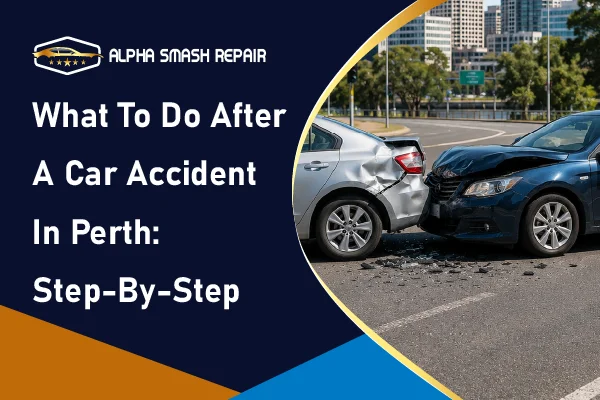
Every drive feels normal — until it doesn't. Perth's road network is vast, spanning busy metroways like Kwinana and Mitchell, sprawling suburban arterials, and quiet residential streets across the metro area. One moment everything feels fine, the next moment you're involved in a major car accident, experiencing your bumper being crushed, and your heart is racing.
With over 1.4 million registered vehicles in Western Australia, car accidents are an unfortunate reality for many drivers in Perth. Knowing exactly what to do after a car accident in Perth can protect your safety, safeguard your legal rights, and make your car insurance claims smoother.
This guide walks Perth drivers through the right steps to take after a minor or major road accident, from the immediate seconds after impact to lodging an insurance claim and getting your vehicle back from a smash repair shop.
Step 1: Stop, Check Yourself & Passengers for Injuries
The moment a serious car crash happens, stop your car immediately, apply the handbrake, and switch on your hazard lights. Under the Road Traffic Administration Act 2008 (WA), it is really important to stop your car, whether you are at fault or in a no-fault transport accident. Failing to stop your car can create serious legal issues for you.
Once stopped, take a few minutes to breathe and assess your own condition before doing anything. What feels like a minor shock can become significant, so don't panic; just handle the situation calmly.
Check yourself and your passengers:
- Can you move and communicate normally?
- Is there any pain in your neck, back, or head?
- Is anyone visibly injured?
- Are your passengers, including children, conscious and responding?
Do not move anyone who has a neck or other injury; it's better to wait for emergency services to arrive.
Step 2: Call 000 If Someone Needs Serious Help
If anyone has been injured — no matter how minor it appears — call 000 and request both police and ambulance immediately. Emergency services in Perth are required to attend any car accident involving injury, and police will file an official report, which is critical for your insurance claim.
Even if injuries seem minor at the scene, some conditions like whiplash, concussion, or internal trauma may not present symptoms for hours or even days. Erring on the side of caution and calling an ambulance during a vehicle crash is the right approach.
You should also call 000 (police) if:
- There is a fire.
- The other driver is intoxicated, uncooperative, and aggressive.
- The accident has caused significant property damage.
- A government or council vehicle is involved.
- The driver leaves the scene without stopping.
- The accident is causing a significant hazard on the main traffic road.
In Western Australia, you're legally required to report a car accident to WA Police within 24 hours if the accident resulted in severe injury, or if the combined property damage exceeds $3,000 and the other party's details are not exchanged. You can contact them online or via the nearest police station.
Step 3: Move Your Car to a Safe & Secure Place
If your vehicle is drivable, move it to a safe destination. Leaving a damaged vehicle in an active lane significantly increases the risk of further car accidents, particularly on busy Perth arterial roads or the freeway network.
Turn on your hazard lights immediately. If you have them available, place road safety triangles or flares behind your vehicle to warn approaching drivers, particularly on high-speed roads like the Kwinana or Mitchell freeways.
Stay well clear of traffic, and keep other passengers and bystanders away from the road. If a vehicle is leaking fuel or you can smell gas, move everyone at least 30 metres away and do not attempt to open the bonnet.
If a car accident occurs at night, you should be cautious about visibility. Wear light-coloured clothing if possible, and use your phone's torch to make yourself visible to oncoming drivers. Please do not stand between your car and oncoming traffic. Perth's freeways and major roads can carry fast-moving traffic around the clock, and secondary collisions involving people standing near stricken vehicles are at greater risk.
Step 4: Exchange Details With Other Drivers
Exchanging details with another driver in a transport accident is both a legal requirement and an essential step for an insurance claim. Under Western Australian law, all parties involved in an accident must provide details to each other.
Collect the following driver details involved in the accident:
- Driver's full legal name
- Current home or postal address
- Preferred contact number
- Vehicle registration details
- Insurance provider information and policy reference number
- Licence identification number and validity date
- Vehicle brand, model, and colour
Both drivers should exchange these details. Keep the interaction with other drivers calm and factual. Avoid any arguments, and please do not admit you are at fault or say sorry, because it can be misinterpreted as an admission of fault and create problems in your insurance claim process.
It is also worth noting that you are not legally required to share which insurer you use, though many people choose to share this voluntarily. However, if you share your insurer's details, ensure the information you provide matches what you later report to your insurer, as inconsistencies can raise red flags.
If the other driver refuses to share their details or leaves the scene, record their licence plate and vehicle details, then contact WA Police immediately.
Step 5: Gather Evidence at the Scene
The right time to collect evidence is immediately after the car accident. Thorough evidence collection decides whether the insurance claim is successful or disputed. Both insurers and courts rely on photographic evidence to determine what exactly happened in the road accident.
You should record:
- Any damage in the form of scratches, dents, or other structural damage
- The position of the vehicles during the impact
- Skid marks, significant debris, or road damage
- Relevant road signs, traffic lights, or markings
- The surrounding environment, road conditions, weather, and lighting
- Evidence of injury to yourself and passengers
- The other driver's licence and registration documents
Witness Details: Ask for a name and phone number from witnesses as well. Witness accounts can be invaluable if fault is disputed. Note down anything they say about what they observed while it's fresh.
Dashcam Footage: If you have a dashcam, save or back up the relevant recording as soon as possible. Some dashcams loop and overwrite automatically, so prioritise this as soon as you are safely away from the accident scene.
Step 6: Write Down Your Own Account
Many people have trouble remembering key details after a shocking incident. As soon as you are safely out of the immediate situation — whether at the roadside or once you've reached a safe location — write down everything you can remember about how the accident happened.
It includes:
- The time, date, exact location, and vehicle registration numbers
- The direction each vehicle was travelling
- Weather and road conditions at the time
- Record of images of visible damage
- Traffic signals, speed limits, or road markings relevant to the scene
- What you were doing immediately before impact
- What you observed the other driver doing
- Statements made by the other driver
- Details of witnesses
This written account will serve as your personal record and may be referred to during insurance negotiations or, in serious cases, legal proceedings. Write it in plain language — describe exactly what you saw, heard, and experienced. Do not try to draw conclusions about the at-fault driver; simply record the facts as you experienced them.
If you have children or other passengers in the vehicle at the time of the accident, note also what happened to them. Passenger statements can sometimes provide a useful independent perspective, especially if the collision occurred from an angle that was more visible from the passenger side.
Step 7: Contact Your Insurance Company
Share the details of the road collision with your insurer on the same day. Many insurers do not prefer delays, as they can create problems within your claim process.
After contacting your insurer, be ready to provide:
- Your policy number
- The time, date, and location of the accident
- A factual description of how it occurred
- The other driver's details and vehicle information
- Whether police attended or a report was filed
- Details of any injuries
- Your photos, dashcam footage, and witness information
Stick to the facts while sharing information with your insurer. Do not misrepresent fault, and don't minimise any injuries or vehicle damage. Also share medical information if relevant.
Understand Your Insurance Coverage in Australia
- Compulsory Third Party (CTP) Insurance: All registered vehicles in Western Australia must carry CTP insurance, which covers injury claims made against you by others injured in an accident. In WA, CTP is part of vehicle registration and managed by Insurance Commission of WA (ICWA).
- Third Party Property Damage Insurance: Helps cover expenses for damage you have caused to others.
- Comprehensive Car Insurance: Provides cover for your vehicle and third-party damage. This is the most common cover for Perth drivers and is the policy most relevant to getting your vehicle repaired after an accident.
Be transparent and consistent while lodging your claim with the insurer. Your insurer will cross-reference your account with other drivers' versions of events, any police report, or photographic evidence.
Inconsistencies — even minor ones — can delay your claim settlement. Keep a record of every conversation you have with your insurer, including the date, time, and name of the representative you spoke with. Follow up calls with a brief email.
Most comprehensive policies cover rental car or hire vehicle benefits while your car is being repaired. Ask your insurer about this benefit during the claim process, because many Perth drivers don't even know about it. If the car accident was the other driver's fault, you can get a hire car at no cost if it's included in your policy coverage.
If you are not at fault in a car accident and the other driver is not insured, you can make a claim through the Uninsured Third Party (UTP) Scheme administered by ICWA. It provides compensation for injuries caused by unidentified or unregistered vehicles in WA.
Step 8: Seek Medical Attention
Don't downplay your need for medical care. Visit a doctor within 24–48 hours, even without any symptoms, after the road accident. Many common accident-related injuries include whiplash, soft tissue injuries, and mild concussion. These medical issues do not always cause problems early on but can develop into serious, chronic conditions.
Seek urgent medical attention if you experience:
- Headache, dizziness, or blurred vision
- Neck or back pain
- Nausea or loss of consciousness
- Numbness or tingling in your limbs
- Emotional distress, anxiety, or disorientation
Keep all medical records, GP visit summaries, specialist referrals, and receipts for any treatment, including physiotherapy, chiropractic care, or psychology. These documents are essential if you need to make a CTP injury claim through ICWA or if you are pursuing damages from the at-fault driver.
It is also worth noting that psychological injury is a recognised and compensable harm under Western Australian law. If you are struggling emotionally in the days or weeks after the accident, speak to your GP and ensure this is documented.
Step 9: Report the Accident to WA Police
In Western Australia, you're legally required to report a road accident to WA Police if:
- Anyone is injured or killed
- The property damage exceeds $3,000 in total, and details were not exchanged
- The other driver failed to stop and exchange details
- A hit and run occurred
Reports must be made within 24 hours; you can make a report online via the WA Police website (police.wa.gov.au) or in person at the police station near you.
Step 10: Arranging a Tow Truck
If your vehicle is not in driving condition, you will need a tow truck to move it to a smash repairer safely. This is a step many Perth drivers overlook.
Do You Need a Tow?
Determine whether the car is safe to drive before calling a tow truck.
You should arrange a tow if:
- Airbags have deployed
- There is significant structural damage to the body or frame
- A tyre is flat, or the wheel is damaged
- Fluids are leaking from the engine or underneath the vehicle
- The steering or brakes feel compromised
- Visibility is obstructed due to a damaged windscreen or bonnet
Hiring a tow truck is better than driving a damaged car.
Why Arrange the Tow?
You should call your insurer or RAC roadside assistance provider. Be cautious of tow truck operators who arrive unsolicited at the accident scene. Tow truck operators should be licensed and regulated under the Tow Truck Industry Act 1999 (WA).
What Are the Different Towing Procedures?
- Flatbed/Tilt Tray Tow Truck: The vehicle is loaded onto a platform and transported without any wheels touching the road. Safest option for damaged, low-clearance, or all-wheel drive vehicles.
- Hook and Chain: An older method where chains are hooked under the axle or frame to drag the vehicle. Rarely used today, as it can scratch bumpers and damage the drivetrain.
- Wheel Lift Tow Truck: Carries part of the vehicle using a yoke, keeping the remaining two wheels grounded. Quicker and more affordable than a flatbed, but not ideal for AWD or 4WD vehicles.
- Dolly Towing: The front (or rear) wheels are placed on a small two-wheeled trailer called a dolly, keeping them off the ground. Often used alongside a wheel lift for long-distance towing of FWD vehicles.
Where to Tow?
If you have a preferred smash repairer in mind, instruct the tow truck driver to take your vehicle directly there. Confirm the destination first if the insurer arranges the tow for you.
Top Signs Your Car Needs Quick Smash Repairs
| Sign of Damage | Why Quick Smash Repairs May Be Needed |
|---|---|
| Cracked or hanging bumper | Loose bumper parts can become a safety hazard and may worsen with driving |
| Broken headlights or taillights | Damaged lights can dim your visibility and make your car harder to spot for others |
| Doors, bonnet or boot won't close properly | Misalignment can indicate underlying panel or structural damage |
| Fluid leaking from the vehicle | Leaks may point to damage to mechanical components and should be inspected promptly |
| Steering feels unusual | Pulling, shaking, or uneven steering often points to suspension or alignment damage underneath |
| Dashboard warning lights appear | Warning lights after a crash may indicate damage to safety or mechanical systems |
| Cracked windscreen or damaged glass | Broken glass can affect visibility and may compromise vehicle safety |
| Damaged sensors or cameras | Modern safety systems may need inspection and recalibration after an impact |
| Wheels or tyres are damaged | Bent wheels or damaged tyres can affect handling and make the vehicle unsafe to drive |
Step 11: Arrange a Vehicle Repair Through a Trusted Smash Repairer
Once your vehicle has been towed or driven to a repairer, the focus shifts to getting it back into pre-accident condition. How this works depends on your insurance cover, whether fault has been determined, and the extent of the damage.
If the damage is severe, your insurer may decide the vehicle isn't worth repairing at all — it's worth knowing how to check whether your car is a write-off before repairs begin
Insurer Referred or Choosing Your Own Repairer
Many insurers will suggest their own preferred repairers, which can streamline the repair process. Some insurance policies give you complete freedom to choose your own repairer. Choosing an independent, reputable Perth smash repairer can deliver better results, particularly for complex structural repairs, panel work, or vehicles requiring ADAS recalibration after the crash.
While choosing a smash repairer, look for:
- A licensed Motor Vehicle Repair Industry (MVRI) repairer, as required under WA law
- Positive reviews and strong local reputation
- Experience with your vehicle make and model
- The ability to handle insurance claims directly
- Use of genuine and manufacturer-approved parts
- A written repair quote and warranty on workmanship
What Repairs Might Be Needed
- Panel beating and paintwork
- Structural frame repair or replacement
- Bumper, headlight, or glass replacement
- Airbag system inspection and replacement
- ADAS sensor recalibration
- Mechanical checks on suspension, steering, and drivetrain
- Detailing and finishing to pre-accident condition
ADAS Recalibration Importance
Modern vehicles are fitted with Advanced Driver Assistance Systems — autonomous emergency braking, lane departure warning, blind-spot monitoring, and more. After any crash, these sensors can be knocked out of alignment without any visible damage. Always confirm with your repairer that ADAS recalibration is included in the repair scope.
What Not To Do After a Car Accident
- Don't admit fault at the scene: Never admit fault or say sorry to the other driver.
- Don't leave the accident scene: Leaving an accident scene in Australia is a crime.
- Don't accept a cash settlement on the spot: Verbal or cash agreements at the scene have no legal standing and could leave you significantly out of pocket.
- Don't exaggerate your injuries or damage: Providing false information may create problems with insurance claim assistance.
- Don't post about it on social media: What you post on social media can be used against you during an insurance claim.
- Don't delay your repairs: Leaving accident damage unrepaired can create safety risks and may impact your insurance payouts.
Situations To Be Aware Of
Hit and Run Accidents in Perth
If the other driver leaves the scene, note down as much detail as possible, including:
- Vehicle's registration plate
- Colour, make, and model of vehicle
- The direction it headed
Contact your insurer and the police without delay. If the at-fault driver is unknown, you can make a claim through the Nominal Defendant Scheme administered by ICWA.
Accidents Involving an Uninsured Driver
When the other at-fault driver is uninsured, compensation may be difficult to obtain.
Your options include claiming through:
- Your comprehensive policy
- Pursuing the other driver personally through the Magistrates Court of Western Australia for property damage costs
In these cases, taking legal advice from a professional familiar with traffic law is strongly advisable.
Accidents on Private Property
Accidents that occur on private property, such as shopping centres, follow the same basic principle: stop the vehicle, exchange details, document the scene, and contact your insurer. In these private property accidents, it can be trickier to determine who is at fault.
The normal road rules help establish fault. Your insurer will check documents, CCTV footage, and witness details to make a determination in a private property accident case.
Single Vehicle Accidents
If you have hit something other than another vehicle, such as a bollard or a kangaroo, the insurance claim process is slightly easier. Contact your insurer, document the scene, and cover your damage through your insurance policy.
Quick Reference: Post Car Accident Checklist for Perth Drivers
- Stop your vehicle immediately.
- Look for injuries among all those involved in the accident.
- If someone is seriously injured, call 000 immediately.
- Move vehicles to a safe place and turn on the hazard lights.
- Exchange names, addresses, licence numbers, and rego details.
- Take photos of significant vehicle damage and the scene.
- Collect witness names and contact details.
- Record your version of the incident.
- Back up dashcam footage.
- Notify your insurance company.
- See a doctor within 24–48 hours.
- Report to WA Police if required (within 24 hours).
- Book your vehicle in with a licensed Perth smash repairer.
Frequently Asked Questions
Is police reporting required for minor accidents in Western Australia?
No, it's not. If someone is injured or your car has been extensively damaged, then it's important to report the incident to WA Police; otherwise, reporting to your insurer is enough.
What if I have to deal with an at-fault driver who is uninsured?
You can claim through your own comprehensive policy or pursue the other driver through the WA Magistrates Court for property damage costs. If the accident involved personal injury, the Uninsured Third Party (UTP) Scheme administered by ICWA may also apply. It's better to speak with car accident lawyers.
Can I choose a professional smash repairer myself?
Yes, in Western Australia, you generally have the right to choose your own repairer regardless of your insurer's preference.
What type of tow truck should I book for my car?
For most modern vehicles, especially AWD, 4WD, automatics, and low-clearance cars, always request a flatbed or tilt tray tow truck. Avoid hook and chain towing for any modern vehicle.
How soon after a road accident should I see a doctor?
You should seek medical assistance within 24–48 hours after a road accident. Otherwise, minor injuries can worsen or develop into serious problems later.
The Bottom Line!
A car accident is a horrifying experience for every driver, but being prepared with the right insurance claim steps helps you achieve a successful outcome. Whether you're driving on Perth roads, the highway, or other busy locations, accidents can happen even to the most careful drivers.
The steps you take after a car accident help you restore your car without paying extra costs, as quickly as possible.
Pro Tip: Choose a trusted smash repairer who can handle your car accident repairs with confidence.